A crooked steering wheel after an alignment usually stems from uneven toe settings or rear thrust angle errors. Correcting this requires resetting the steering column clamp, re-evaluating tie rod adjustments, and verifying angles through a road test to restore precise vehicle tracking and prevent premature tire wear.
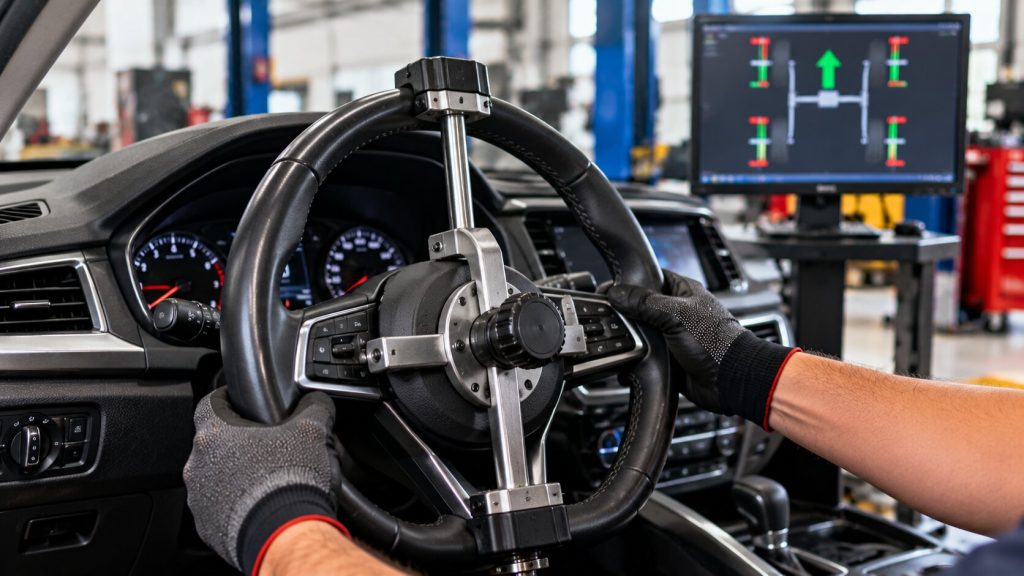
A crooked steering wheel immediately following an alignment points directly to an incomplete setup or a shift during service. Leaving the rack with an off-center wheel happens when technicians miss precise centering before locking down adjustments. Navigating rough desert pavement and expansion joints on Campbell Avenue quickly exposes these calibration errors.
Understanding Why Your Steering Wheel Remains Crooked
Our technicians must lock the steering wheel in the absolute straight ahead position before adjusting the steering angles underneath the vehicle. If the steering wheel is allowed to shift even slightly while locking down the front toe settings, the wheel will track crookedly when you drive straight.
| Diagnostic Metric | Technical Detail |
| Primary Symptom | Steering wheel cocked to the left or right while driving straight |
| Target Component | Front tie rod adjusters or rear thrust angle geometry |
| Specialized Tooling | Steering wheel clamp and high definition optical alignment rack |
| Local Stressor | Potholes and expansion joints on Campbell Avenue |
| High Risk Profile | Vehicles with worn suspension bushings or prior steering work |
The Mechanics of Toe Settings and Steering Angles
Front toe refers to the directional angle of your tires relative to the centerline of the vehicle, determining whether they point inward or outward. When we adjust toe settings, both left and right front wheels must be symmetrical so that the steering gear centers itself naturally. If one tie rod is adjusted more than the other without locking the steering wheel column, the steering gear box centers off the axis. The vehicle still tracks straight down the highway, but the actual steering wheel sits at an awkward angle.
Rear thrust angle errors can also cause a crooked steering wheel even if the front wheels look correct. The thrust angle measures the direction the rear wheels point relative to the vehicle centerline. If the rear axle or rear control arms are out of adjustment, the car naturally tracks sideways down the road. To compensate for this sideways tracking, drivers must hold the steering wheel slightly turned just to go straight ahead.
Our Precision Protocol for Correcting Steering Center
Fixing an off center steering wheel requires returning the vehicle to our alignment rack for a proper recheck and mechanical adjustment. Our experienced team follows a precise diagnostic protocol to pinpoint and resolve steering alignment errors:
- Component Inspection: Inspecting suspension components like tie rod ends, ball joints, and control arm bushings for excessive play or wear before any adjustments begin.
- Cabin Calibration: Mounting a specialized mechanical steering wheel holder inside the cabin to lock the steering wheel perfectly level during the alignment process.
- Mechanical Adjustment: Lifting the vehicle, loosening the tie rod jam nuts, and carefully equalizing the left and right toe adjustments to balance the steering geometry.
- Sensor Reset: Calibrating the steering angle sensor using an advanced OBD2 diagnostic scan tool for modern vehicles equipped with electronic power steering systems.
- Verification Road Testing: Performing a final road test to ensure the vehicle tracks true and the steering wheel remains centered under acceleration, cruising, and braking conditions.
Prevent Further Tire Wear and Handling Issues
An unaligned steering wheel accelerates tread wear by scrubbing rubber sideways against the pavement. Correcting the underlying toe or thrust angle geometry preserves your tire lifespan and maintains proper suspension load tolerances.
Drivers experiencing persistent handling quirks can turn to our technical team at Accurate Service Auto Repair located at 843 S Campbell Ave, Tucson, AZ 85719 for precise diagnostics and calibration. Visit our shop or call us at (520) 622-7685 to schedule your alignment verification today.
Frequently Asked Questions
Can a bad alignment cause my steering wheel to stay off center?
Yes, incorrect toe adjustments or a shifted rear thrust angle will directly cause the steering wheel to sit crookedly. When front or rear angles are asymmetrical, the steering wheel must be turned off center to keep the vehicle moving straight.
Will an off center steering wheel ruin my tires?
Driving with a misaligned steering wheel indicates improper toe settings that scrub the rubber sideways across the pavement. This creates rapid tread wear, feathering, and bald patches that shorten the lifespan of your tires.
Why did my steering wheel become crooked right after a fresh alignment?
This typically occurs due to minor settling in worn suspension components as the vehicle transitions off the alignment rack, or if an older tie rod adjuster slips slightly under final torque loads. Our precision recheck process locks down all hardware and recalibrates the steering angle sensor to correct this immediately.
How long does it take to fix an off center steering wheel?
A professional recheck and adjustment typically takes between thirty minutes and an hour depending on whether suspension components need replacement. We will mount the steering wheel clamp, readjust the toe settings, and perform a brief road test to verify the fix.